General Psychology - Applied (eBook). Lannerholm, V. (2024). Kendall Hunt Publishing, ISBN: 9798385133024
Forthcoming release: December 2026
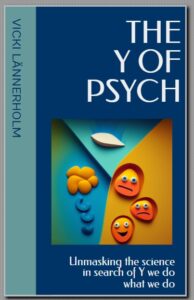

The internet and science – a rolling cart of news and stress that hijack our drive for novelty. Breadcrumbed by the latest posts we scroll, sample, and taste, both the useful and useless in search of Y we do what we do. Every study another slab of peanut butter consumed as we head for our next fix.
At best we’re left wandering between circumstantial evidence like mice in a maze. At worst we’re circling a drain of pathology.
Psychology is the #1 interest in education, work, and relationships. Yet, even as we think we’re gaining insights, the amount of information exposure far exceeds what our mind can manage. This makes it nearly impossible to reflect and integrate. As a result, the brain’s selection process becomes a game of Russian roulette leaving us vulnerable to biases, misunderstanding, even illness, and blinded to our potential.
Since the brain likes things easy, without a more favorable threshold of novelty, it may favor what’s familiar. That which we already have in storage in order to give meaning to our experiences.
When flooded by online media, data and labels, it formulates perceptions subliminally and filters to confirm them. No questions asked and algorithms don't help. When it comes to students and clients this is an increasingly complex problem that undermines therapeutic change and learning.
You’ve probably experienced this when trying to break a habit or convince someone of your point of view, unsuccessfully. Mental frameworks can be powerfully stubborn once set and they inform everything we think and do.
It begs to question, how far down the scientific rabbit hole should we go? Are there universal “laws of psychology” like "laws of gravity" that we can trust?
The answer is yes, and scientific principles of parsimony demonstrate that the most empowering explanations remain simple ones.
As the latest research teases us along we need a model to organize a range of “normal” and avoid self-help to-do lists. In response I have compiled my reflections from teaching college psychology courses into a model of set lessons. A framework for recycling the science into a management tool for understanding yourself and others beyond a diagnosis.